
Notary
- Home
- Services
- OTHER LEGAL
- Notary
Notarization
Notaries are required when an independent witness is needed to authenticate and certify legal documents and or transactions within their respective jurisdictions.
By virtue of a state’s delegation, a notary public is given the legal ability to confirm oaths, oversee paperwork completion and forestall any kind of deceit by authenticating the identity of someone signing an agreement.
Don't Sign Yet
Pre-signed documents are a common mistake seen. Although this can be rectified by simply signing the document again in the presence of the Notary, it can be a little messy.
It is best to wait until the Notary asks you to sign, as swearing an oath might also be required.
Documents We Notarize
For Individuals
- Powers of Attorney
- Affidavits/Oaths
- Statutory Declarations
- Copy Passports
- Copy Documents
- Written Statements
- Application Forms
- Mortgage Documents
- Property Purchases
- Adoption Documents
- Certificates of Law
- Company Documents
For Businesses
- Powers of Attorney
- Affidavits/Oaths
- Statutory Declarations
- Good Standing Certificates
- Certificates of Law
- Certificates of Incorporation
- Written Statements
- Trademark Assignments
- Application Forms
- Ship Mortgages
- Share Pledges
- Property Purchases
IPEN and RON aren’t the same thing. While they share some similarities — namely being electronic notarizations — there are fundamental differences
A RON does not require the signer to be in the same physical location as the Notary. Depending on state law and the service being used, the process involves the system establishing the identity of the signer prior to interacting with the Notary. The notary also verifies the signer’s identity using the same identification documents that are required for a traditional in-person notarization. The signer “signs” the document electronically and the Notary affixes his or her electronic signature and seal to the digital document. The audio and video of the notarial act is typically recorded.
The notarization is executed traditionally, though the documents are presented in a digital format and signed using an electronic signature. The Notary uses an electronic seal and signature to notarize the document.
Apostille Services
An Apostille or Authentication validates the genuineness of the signature, seal, and authority of the official endorsing, issuing, or attesting to a copy of a public document. It serves to confirm that a public document originating in one country holds legal validity in another country. In compliance with legal standards, we offer expedited apostille services in Newark, New Jersey for a variety of documents, including but not limited to:
- Marriage Certificates
- Birth Certificates
- Death Certificates
- Power of Attorney
- Personal Documents
- Divorce Decrees
- Notarized documents
- Business documents …
throughout all Counties and Cities in the State of New Jersey, notably Essex County. Our Newark Apostille service streamlines the authentication process by directly liaising with the New Jersey Secretary of State’s office.
The New Jersey Secretary of State will affix either an Apostille or a Certificate based on the requesting country’s specifications. A comprehensive list of Hague Apostille Member Countries as well as non-member countries can be accessed here: Hague Apostille Member Countries.
Step 1 – Verification Consultation: Prior to dispatching your documents to our office, a preliminary discussion is required to ascertain the eligibility of your documents for Apostille. Kindly reach out to us via our website or call us at toll-free at 1-833-773-2533 for verification. Our customer service personnel are available Monday to Friday from 8am to 7pm.
Step 2 – Document Submission: Original or certified copies of your documents must be submitted to our office via mail.
Processing duration in the State of New Jersey typically spans 3-5 business days (excluding Saturday, Sunday, and major holidays), with additional time allocated for FedEx return shipping. We recommend utilizing FedEx, UPS, or Priority/Express Mail from the United States Postal Service for document submission. Kindly access our order forms or contact our office for comprehensive guidance and forms via email.
Complimentary FedEx/UPS Next Day return shipping within the United States is provided. Global document delivery services are also offered with applicable international shipping rates (For precise quotations, kindly reach out to us).
We accept various payment methods such as credit cards, electronic transfer funds, Zelle, Detailed discussions on payment alternatives can be arranged by contacting our office. To expedite processing, please ensure completion of our order form and credit card authorization form, alongside submission of these documents alongside your original documents.
Apostille processes are intricate. Entrust this task solely to proficient professionals well-versed in the New Jersey Apostille process and the distinct requirements of various countries. Inadequate handling of this procedure by untrained personnel can lead to document rejection, incurring substantial time and monetary costs. Safeguard against such setbacks.
In addition to our services in Newark, New Jersey, we also handle document authentication from all 50 U.S. States, encompassing the U.S. Department of State in Washington, DC (Federal Documents), the Secretary of the District of Columbia, and specific Embassy & Consulate offices.
Turnaround times may vary and will be determined case by case.
Jurat
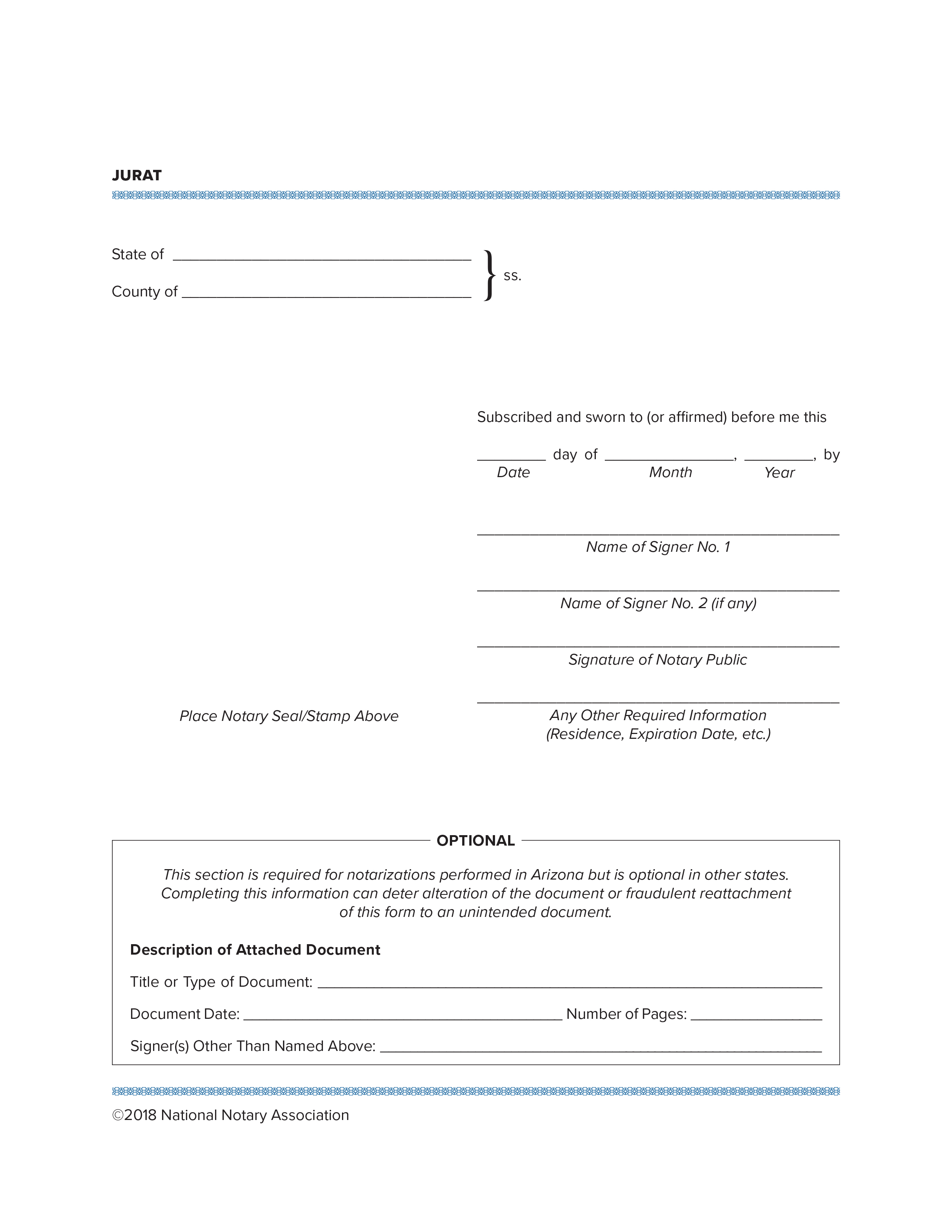
The two most common notarizations requested are Acknowledgments and Jurats; but not everyone knows the difference between these two acts.
What Is A Jurat?
1. The signer must appear in person before you and sign the document in your presence.
2. In some states, you are required to positively identify the signer.
3. You must administer a spoken oath or an affirmation, and the signer must respond out loud. Silent answers such as a nod of the head are not acceptable.
While not required by law, it is strongly recommended that you have the signer raise his or her right hand to emphasize the seriousness of the oath or affirmation.
A jurat cannot be executed by someone offering to take the oath in someone else’s name — the original signer must swear or affirm the oath in person before the Notary.
Acknowledgment And Jurat Certificates
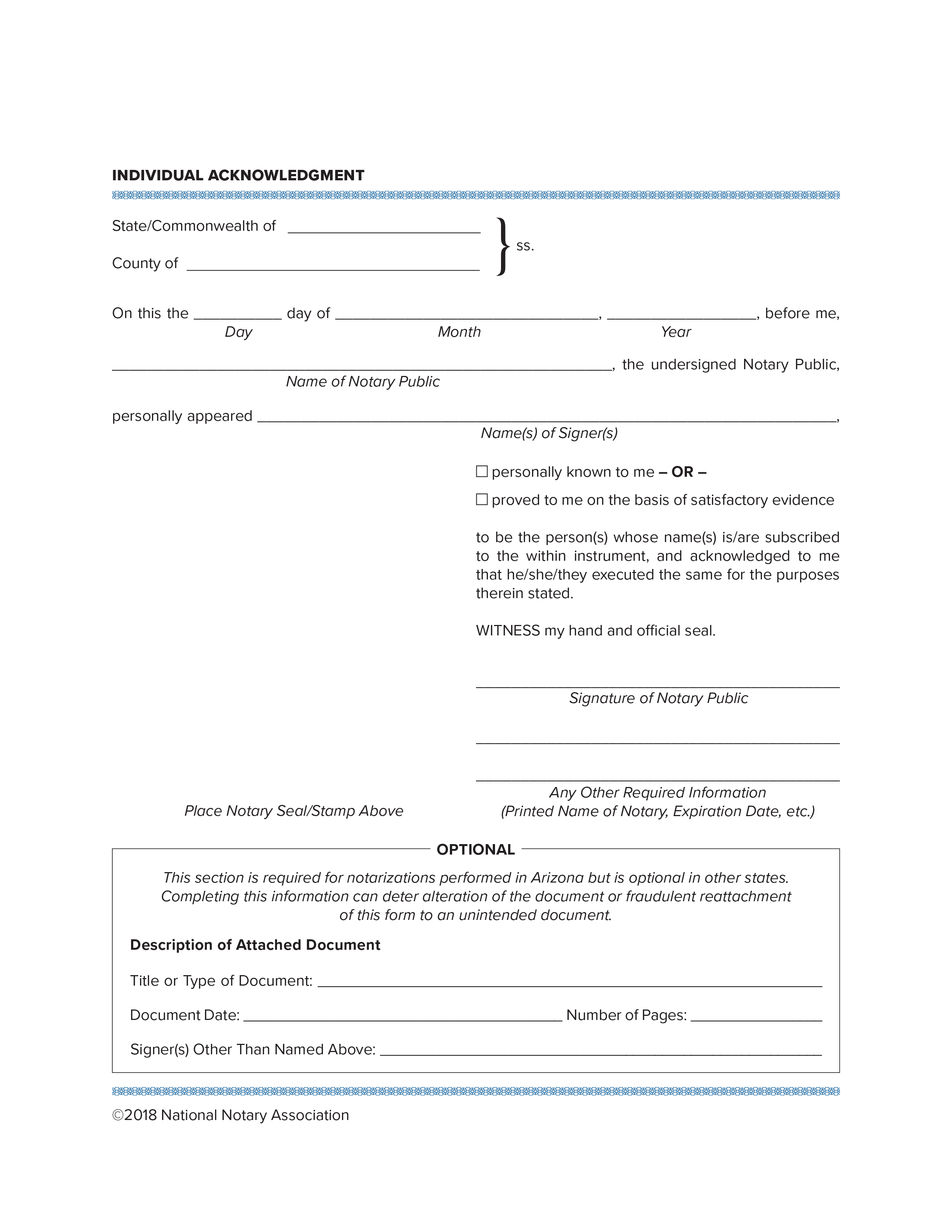
Because acknowledgments and jurats are different notarizations with different purposes, each requires its own certificate wording. You cannot use a jurat certificate for an acknowledgment, or vice versa. Make sure you use certificate wording that is acceptable under your own state’s rules.
In general, an acknowledgment certificate will contain the words, “acknowledged before me” or similar wording. Jurat certificates will contain the words, “subscribed and sworn to (or affirmed) before me.”
A jurat requires the following steps:
1. The signer must appear in person before you and sign the document in your presence.
2. In some states, you are required to positively identify the signer.
3. You must administer a spoken oath or an affirmation, and the signer must respond out loud. Silent answers such as a nod of the head are not acceptable.
While not required by law, it is strongly recommended that you have the signer raise his or her right hand to emphasize the seriousness of the oath or affirmation.
A jurat cannot be executed by someone offering to take the oath in someone else’s name — the original signer must swear or affirm the oath in person before the Notary.
What Is An Acknowledgment?
The purpose of an acknowledgment is for a signer, whose identity has been verified, to declare to a Notary or notarial officer that he or she has willingly signed a document.
A jurat requires the following steps:
1. The signer must appear in person before you and sign the document in your presence.
2. In some states, you are required to positively identify the signer.
3. You must administer a spoken oath or an affirmation, and the signer must respond out loud. Silent answers such as a nod of the head are not acceptable.
While not required by law, it is strongly recommended that you have the signer raise his or her right hand to emphasize the seriousness of the oath or affirmation.
A jurat cannot be executed by someone offering to take the oath in someone else’s name — the original signer must swear or affirm the oath in person before the Notary.
The signer must be able to directly communicate with you that he or she willingly signed the document. Arizona is the exception to this rule. Arizona state law permits a signer to communicate with a Notary through a translator who is also present at the notarization.
Legalization
Legalization is the official process of document authentication granted by international governments. Documents deemed necessary for use in a foreign country that are not members of the Hague/Apostille Convention, require Legalization. The process consists of a series of authentications. Your document(s) must first be authenticated and notarized, then validated by an Embassy or Consulate.
Apostilles authenticate the seals and signatures of officials on public documents such as birth certificates, court orders, or any other document issued by a federal agency or certified by an American or foreign consul. An apostille certifies the document(s), so the document can be recognized in foreign countries that are members of the 1961 Hague Convention Treaty.
Apostilles are only issued for federal documents to use in countries that are members of the 1961 Hague Convention.
Presently, more than 200 countries accept foreign documents certified by apostille. However, there are certain restrictions regarding its acceptance. Some countries still reserve the right to deny the acceptance of apostillized documents, issued by other countries, which are also parties to the Convention. For example, documents apostillized in Albania, Kyrgyzstan, Uzbekistan, Mongolia and the Dominican Republic are not recognized by Germany, Belgium, Greece and Spain, in spite of all these States having signed the international agreement. In cases such as this, and in case the documents are intended to be presented in a country, which is not a party of the Apostille Convention, a chain, multi – step embassy or consular legalization of documents is required to be done by a foreign authorities in order to be recognized
A single missed step or blunder in the Legalization process can be detrimental to your deadline and bottom line. Countless individuals get rejected daily due to incomplete or improper Legalization processing. Additionally, most of our customers dread the idea of running around to multiple government agencies, fighting for parking or riding on public transportation, going through metal detectors, waiting in long lines, buying money orders, dealing with bad attitudes, etc..
What steps are involved?
The steps you must take to have a document legalized vary by country. It depends on the agreements made between the country where you want to use the document and the country that issued it.
Sometimes you must also have your document translated by a sworn translator. Ask the authorities in question if this is necessary and, if so, where you can have this done. where you can have this done.
In many countries, you can have your document legalized with an apostille. This is a simplified form of legalization. An authority in country A legalizes the document with a type of stamp or sticker, known as an ‘apostille’. After this, no more steps are necessary. You can use the document in all the countries that are party to the Apostille Convention.
If one or both of the countries involved in your legalization is not a party to the Apostille Convention, then legalization often involves two steps:
Step 1
An authority in Country A checks that the document has been signed by the relevant official authority in Country A. It is usually the Ministry of Foreign Affairs in Country A that does this. After approval, a stamp or sticker is placed on the document. This shows Country B that the document has been issued by a competent authority in Country A.
Step 2
Country B checks and legalizes the document with a stamp or sticker. Usually, this is done by an embassy, consulate-general or honorary consul of Country B in Country A. After legalization you can use the document in Country B.
Legalisation is not necessary if Country A has an agreement with Country B exempting your type of document. If so, you can use your document in Country B without having it legalised. Several countries also have reciprocal agreements. Under the EU Regulation on Public Documents, for instance, public documents issued in one EU member state do not need to be legalized for use in another.
Sometimes, legalization is not possible in a given country. For instance, because of war or conflict in Country A. Or because there are no authorities that can check the document. If so, the authorities in Country B will check and assess the document.
Who may legalize a document?
You are not required to personally have the document legalized. Someone else may do it for you. It is not necessary to authorize that person to do so.
RELATED SERVICES
FAQs
Notaries do not possess a legal background and, therefore, cannot validate documentation nor guarantee veracity.
We offer In-Person Electronic Notarization, RON and Signing Agent Services.
A valid Photo ID (see our requirements page). However, some other forms of identification may be required, depending on the requesting agency.

